
Terror vs Horror: The Real Difference Explained
Terror and horror are not the same emotion...

Terror vs Horror: The Real Difference Explained
What is the difference between terror and horror?
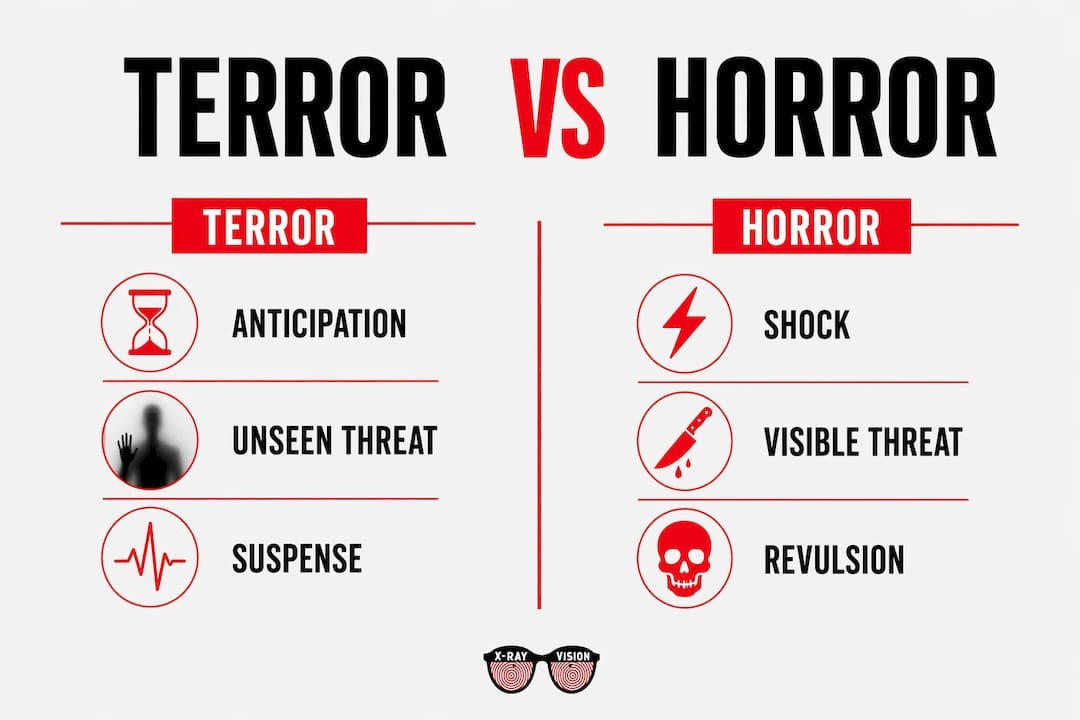
Terror and horror are not the same emotion. Terror is the dread and suspense you feel before a frightening event unfolds. Horror is the shock and revulsion that hits after you’ve confronted the dreadful reality. That single distinction, anticipation versus realization, shapes everything from Gothic novels to modern slasher films.
Ann Radcliffe, the 18th-century Gothic writer who first drew this distinction, described terror as something that “expands the soul and awakens the faculties to a high degree of life.” Horror, by contrast, “freezes and nearly annihilates them.” Stephen King built on that framework centuries later, calling terror “the finest element” of fear in his nonfiction book Danse Macabre, placing it above both horror and revulsion in his three-tier hierarchy.
Here’s how the two emotions break down at their core:
Terror:
Rooted in uncertainty and the unknown
Builds through suspense, dread, and anticipation
Engages the imagination to fill in frightening gaps
Prolongs the emotional experience over time
Produces a freeze response, holding the audience in anxious suspension
Horror:
Triggered by explicit, unambiguous stimuli
Arrives as immediate shock, disgust, or revulsion
Confronts the audience with a visible, concrete threat
Tends to be visceral and short-lived in its initial impact
Can overwhelm emotional faculties when overused
Understanding these two states is the foundation for reading, watching, and writing dark fiction with real depth.
How Ann Radcliffe and Gothic literature defined these emotions
The terror vs horror distinction didn’t emerge from modern film criticism. It was born inside Gothic literature, and Ann Radcliffe planted the seed.
Writing in the late 1700s, Radcliffe used her novels to deliberately cultivate terror rather than horror. Her approach was philosophical: she believed that obscurity and uncertainty were the engines of the most powerful fear. When a reader’s mind is left to imagine what lurks in the shadows, it conjures something far worse than any author could describe outright. That imaginative engagement was, for Radcliffe, the source of the sublime in Gothic fiction.
Keep reading free of charge at my blog: https://blog.markwatsonbooks.com/blog/terror-vs-horror